Face Shapes for Men: How to Find Your Face (2026 Guide)
Learn how to identify face shapes for men using four simple measurements, then choose haircuts, beards, and glasses that balance your features.


Table of Contents
30 SectionsUnderstanding face shapes for men starts with four comparisons: face length, forehead width, cheekbone width, and jawline width. The widest area and the way your jaw and chin taper usually reveal whether your face is closest to oval, round, square, rectangle, diamond, heart, or triangle.
That label is useful because a haircut, beard, and pair of glasses can change how wide, long, soft, or angular your face appears. It is not a beauty score or a rigid rule. Most people sit between two categories, and features such as hair texture, hairline, beard growth, and head shape affect the final result. This guide shows you how to take consistent measurements, interpret them without forcing a perfect match, and turn the result into practical grooming choices.
Quick answer: how to find your face shape
To identify your face shape, pull your hair away from your forehead and measure your face length, forehead, cheekbones, and jawline. Compare which measurement is longest or widest, then check whether your jaw is rounded, square, or tapered. Match the overall pattern—not one number—to the closest face-shape category.
At a glance:
- Oval: longer than wide, with balanced proportions and a gently tapered jaw.
- Round: similar length and width, with soft curves and a rounded chin.
- Square: similar length and width, with a broad, angular jaw.
- Rectangle or oblong: clearly longer than wide, with fairly straight sides.
- Diamond: cheekbones are widest; forehead and jaw are narrower.
- Heart: forehead is widest and the face tapers to a narrow chin.
- Triangle: jaw is widest and the forehead is narrower.
Face shape and head shape are not the same
Face shape describes the outline from the hairline to the chin. Head shape includes the skull and how the head looks from the side and back. A buzz cut, skin fade, or shaved head exposes more of the skull, while longer hair can alter that silhouette. If you are comparing different head shapes, use side and rear views; for facial shape, judge the front-facing proportions.
Individual features such as the nose, eyes, cheekbones, or brow may affect your style preference, but no single feature determines the outline.
How to measure your face correctly
Use a flexible tape measure, a mirror, and your phone or a note pad. Centimeters and inches both work; consistency is what matters. Remove hats and glasses, pull long hair back, and relax your face. If you have a full beard, feel for the jaw underneath it rather than measuring the beard’s outer edge.
Take each measurement twice. If the results differ, average them or measure again.

1. Measure face length
Measure in a straight vertical line from the center of your hairline to the lowest point of your chin. Do not follow the curve of your nose.
If your hairline is uneven or receding, estimate the original center line by using the stable hairline at the sides as a reference. Record that this measurement is approximate. A receding hairline changes the visible frame of the face, but it does not change the position of the forehead, cheekbones, or jaw.
2. Measure forehead width
Measure across the widest part of the forehead, usually about halfway between the eyebrows and the hairline. Keep the tape straight rather than wrapping it around the head.
3. Measure cheekbone width
Find the most prominent point of each cheekbone, generally below the outer corners of the eyes. Measure straight across from one point to the other. Cheekbone width is especially helpful when distinguishing a diamond face from an oval or heart shape.
4. Measure jawline width
Place the tape at the tip of your chin and measure along the edge of the jaw to the point below the ear where the jaw turns upward. Double that number to estimate total jawline length. Alternatively, measure straight across between the two jaw angles. Choose one method and use it consistently when comparing results.
5. Check the outline in a photo
Measurements cannot fully describe curves and angles. Take a front-facing photo in even light with the camera at eye level, your head upright, and a neutral expression. Stand far enough away to reduce wide-angle distortion; using a modest zoom and stepping back is usually better than holding the phone close.
Trace the outer line from the forehead through the cheeks to the jaw. Then ask:
- Are the sides mostly straight or curved?
- Is the chin rounded, broad, or pointed?
- Does the face narrow more toward the forehead or toward the jaw?
- Are the measurements almost equal, or is one clearly dominant?
Do not rely on a single selfie. Camera distance, lens choice, head tilt, facial expression, and lighting can all change the apparent proportions.

Seven common face shapes for men
Use the following face shape chart as a pattern-matching guide. Small measurement differences are normal, so there is no universal cutoff that turns one type into another.
| Face shape | Typical measurement pattern | Outline clues | Often confused with |
|---|---|---|---|
| Oval | Face length is greater than cheekbone width; forehead is slightly wider than jaw | Balanced, gently curved sides and a rounded or softly angled chin | Oblong, round |
| Round | Face length and cheekbone width are close; forehead and jaw are also similar | Full cheeks, soft jaw, few sharp angles | Oval, square |
| Square | Length and width are close; forehead, cheekbones, and jaw are similar | Straight sides, broad forehead, defined jaw angles | Round, rectangle |
| Rectangle/oblong | Face length is clearly the largest measurement; horizontal widths are fairly similar | Long outline with straighter sides; jaw may be square or softly rounded | Oval, square |
| Diamond | Cheekbones are widest; forehead and jaw are narrower | High cheekbones and a tapered or pointed chin | Heart, oval |
| Heart | Forehead is widest; cheekbones are next; jaw narrows toward chin | Broad upper face with a narrow, sometimes pointed chin | Diamond, inverted triangle |
| Triangle/pear | Jaw is widest; cheekbones and forehead narrow upward | Strong lower face and narrower temples | Square, oblong |
1. Oval face shape
An oval face is longer than it is wide, but the difference is moderate rather than dramatic. The forehead is usually a little wider than the jaw, the cheekbones are gently prominent, and the jaw tapers without ending in a sharply pointed chin. The sides form a smooth curve instead of strong corners.
Oval is often mistaken for oblong. Check the amount of length: if the face looks clearly stretched and the forehead, cheekbones, and jaw are nearly the same width, oblong is more likely. Oval faces already look balanced, so the styling aim is usually to preserve that balance rather than create extra height.
2. Round face shape
A round facial shape is about as wide as it is long. The cheeks tend to be the widest area, while the jaw and chin have soft curves with few sharp angles. Round describes the outline, not a person’s weight; lean men can have round faces too.
Round and square faces may produce similar measurements. The difference is definition: a square face has a broad, angular jaw, while a round face has a softer lower edge. Haircuts with height, tighter sides, and diagonal or angular lines can make a round face appear longer and more defined.
3. Square face shape
A square face has similar length and width, with the forehead, cheekbones, and jawline also measuring close to one another. Its main feature is a broad jaw with visible angles. The sides of the face look straighter than those of a round or oval face.
This shape is sometimes confused with rectangle. If face length is clearly greater than width, rectangle is the better match. A short cut can emphasize a square jaw, while texture and slightly more length can soften it. Neither effect is inherently better; the choice depends on the look you want.
4. Rectangle or oblong face shape
A rectangle or oblong face is noticeably longer than it is wide. The forehead, cheekbones, and jawline are often similar in width, creating relatively straight sides. Some stylists call the angular version “rectangle” and the softer, rounder version “oblong,” although many use the terms interchangeably.
The usual styling aim is to avoid making the face look even longer. Moderate top height, a fringe, a low taper, or some controlled side volume can help. An extremely tall top paired with bare sides creates the opposite effect by emphasizing the vertical line.
5. Diamond face shape
A diamond face is widest at the cheekbones. Both the forehead and jaw are narrower, and the chin often looks tapered or pointed. The prominent cheekbone line gives the middle of the face more visual width than the upper or lower sections.
Diamond is commonly confused with heart. The cheekbones are widest on a diamond face; the forehead is widest on a heart face. Texture, a side-swept fringe, or width near the temples can balance the narrow forehead. Very tight sides may make the cheekbones look even broader.
6. Heart face shape
A heart-shaped face has a broad forehead, moderately wide cheekbones, and a jaw that narrows toward the chin. A widow’s peak may strengthen the heart-like outline, but it is not required. The defining pattern is a wider upper face and a narrower lower face.
Heart and diamond shapes both have tapered chins, so compare the forehead with the cheekbones to separate them. Medium-length texture, a side-swept fringe, and some fullness around the jaw or beard can balance the upper and lower face. Excessive height may make the forehead look more dominant.
7. Triangle or pear face shape
A triangle face—also called pear-shaped—is widest at the jaw and becomes narrower through the cheekbones and forehead. It is the reverse of a heart face. The jaw may be rounded or angular, but it remains the dominant horizontal measurement.
Triangle can resemble square when the jaw is strongly defined. Check the forehead: if it is clearly narrower than the jaw, triangle is more likely. Hair with texture or width around the temples can balance the lower face. A very full beard at the sides of the jaw will emphasize, rather than reduce, the triangular outline.
What if your measurements match two face types?
Mixed results are common because face types are styling categories, not strict biological divisions. If your length points to oval but your jaw looks square, “oval-square” is a more useful description than forcing either label. Use the dominant shape for broad guidance and the secondary feature for adjustments.
Try this order when the answer is unclear:
- Start with length versus width. This separates longer oval and rectangle faces from rounder square and round faces.
- Find the widest horizontal area. Forehead suggests heart, cheekbones suggest diamond, and jaw suggests triangle.
- Use jaw shape as the tiebreaker. A soft jaw favors round or oval; a broad angular jaw favors square or rectangle; a narrow chin favors heart or diamond.
- Test the result against real styles. If modest side volume improves the balance but extra height does not, your face may behave more like an oblong shape even if the numbers are close to oval.
For example, suppose a man records a face length of 20 cm, cheekbones of 16 cm, forehead of 15.5 cm, and jawline of 15.5 cm. The longer vertical measurement and similar horizontal widths point toward rectangle or oblong. A softer jaw would support “oblong,” while a strong square jaw would support “rectangle.” These are practical interpretations, not medical diagnoses.
Match your haircut to your proportions
The useful question is not simply, “What haircut belongs to this label?” It is, “What should the haircut visually add or reduce?” Hair can add height, create width, reveal the jaw, cover part of the forehead, or introduce angular lines. Texture, density, curl pattern, growth direction, thinning, and maintenance time still matter as much as facial proportions.
| Face shape | Styling aim | Good starting points | Be cautious with |
|---|---|---|---|
| Oval | Preserve the natural balance | Crew cut, side part, textured crop, quiff, slick back | Extreme height with very tight sides |
| Round | Add length and definition | Pompadour, quiff, faux hawk, angular side part, high-volume textured top | Heavy straight fringe, equal volume on top and sides |
| Square | Emphasize or gently soften the jaw | Crew cut, buzz cut, French crop, side part, short quiff | Boxy styles if you want a softer result |
| Rectangle/oblong | Add width without extra height | Side-swept crop, textured fringe, medium layers, low-volume side part | Tall pompadour, high fade with a long vertical top |
| Diamond | Add width near the forehead | Textured fringe, side-swept style, medium scissor cut, layered top | Ultra-tight temples and flat top volume |
| Heart | Balance a broad forehead and narrow chin | Side-swept fringe, medium textured cut, loose quiff, moderate side volume | Very high, tight styles that widen the forehead visually |
| Triangle | Build visual width higher on the head | Textured quiff, curly top, side part with temple volume, medium layers | Flat top with very tight sides |
Best haircuts for oval faces in men
An oval face gives you room to work with most short and medium cuts. A classic side part, crew cut, textured crop, quiff, or slick back can all suit it. Keep enough hair at the sides to prevent an already-long face from appearing stretched. If the forehead is prominent, a textured or side-swept fringe can adjust the balance without hiding the face.
Haircuts for men with round faces
For a men’s haircut with a round face, the usual aim is vertical lift and cleaner sides. A structured quiff, pompadour, faux hawk, or side part creates direction, while a taper or fade reduces side width. A slightly off-center or angular fringe is generally more helpful than a thick horizontal fringe, which can make the outline look shorter.
Curly and coily hair can create height naturally, but the barber should shape the sides rather than simply remove all volume. Fine or thinning hair may look better with a shorter textured crop and a subtle side part than a tall style that requires density you do not have.
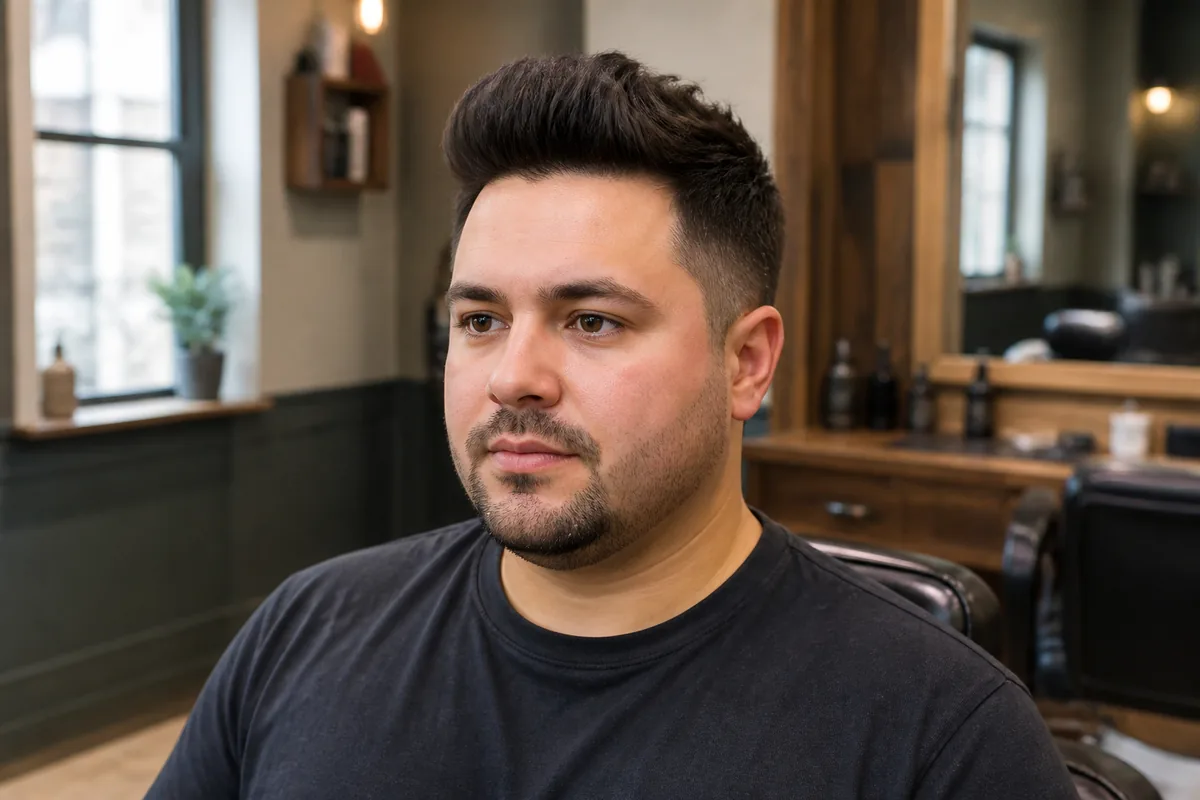
Oblong face hairstyles for men
With an oblong face, keep top height moderate and avoid an extreme contrast between a long top and bare sides. A low taper, side-swept fringe, Caesar-style crop, or medium layered cut can introduce width. Longer hair can also work when it falls around the sides rather than forming a high, narrow shape.
Bring reference photos to your barber, but choose examples with a similar hair type, density, hairline, and beard pattern. Ask how the cut will look without daily styling and how it will grow out between appointments.

Use beards and glasses as a second frame
Hair is only the upper frame of the face. Facial hair shapes the lower frame, while glasses draw lines across the center. These tools can reinforce your natural outline or balance it.
For a round face, cleaner sides and slightly more length at the chin can add definition. A square face can carry short stubble or a close boxed beard that follows the jaw; a fuller, rounded beard will soften it. Men with oblong faces usually benefit from avoiding a very long goatee or pointed beard. More fullness at the sides with controlled chin length can reduce the vertical effect.
Diamond and heart faces often suit beards that add some weight around a narrow chin or jaw. For a triangle face, keep the beard tidy at the jaw and avoid making the lower face much wider unless that is the look you want. Beard growth is rarely perfectly even, so work with your natural density rather than forcing an outline that exposes gaps.
The familiar advice for glasses is to contrast curves with angles: angular frames for a round face and rounder frames for a square face. Treat that as a starting point, not a law. Frame width, bridge fit, lens height, eyebrow position, prescription, and comfort are more important. Diamond face shape glasses often work well when the frame adds visual width near the brow without extending far beyond the cheekbones. Heart faces may prefer frames that do not make the upper face look heavier.

Variables that can change the result
Bone structure is only part of what you see. A receding hairline changes the visible forehead; a beard can conceal the jaw; aging or weight variation can alter cheek fullness; and normal asymmetry can blur the categories. Judge stable landmarks and the overall pattern.
Hair texture and density may also make a suggested style impractical. Adapt the silhouette instead of copying a cut exactly. Automated tools can provide a second opinion, but camera distortion and the app’s classification system affect the result. Check its privacy policy before uploading a face photo. A barber can assess your face, skull, hair, and maintenance needs together.
Common face-shape mistakes
Treating the result as a verdict on attractiveness
There is no single “most attractive face shape” for everyone. Attractiveness depends on features, expression, grooming, taste, and context. A shape category is a design tool, not a ranking.
Measuring the beard instead of the jaw
A beard can make a narrow jaw look square or a round chin look longer. Find the bone beneath the hair and record that measurement. Then consider the beard as a separate styling layer.
Confusing round with square
These types can have similar measurements. The jaw is the deciding clue: a round face has softer curves, while a square face has straighter sides and more visible jaw angles.
Using one celebrity as the template
Two men with the same face type can have different hairlines, neck widths, and textures. Copy the styling principle—not every detail of a celebrity cut.
Following “avoid” lists too rigidly
Style recommendations describe visual effects, not prohibitions. A man with a rectangle face can wear a tall pompadour if he wants a longer-looking silhouette. Personal taste comes first once you understand what the style is likely to emphasize.
Make the label work for you
Start with four measurements, confirm the outline in a neutral photo, and select the closest category or two. Then translate the label into a simple styling goal: add height, create width, soften angles, or reveal structure. That goal is more useful than memorizing a list of approved cuts.
The best guidance on face shapes for men leaves room for hair texture, density, hairline, beard growth, glasses fit, and personal taste. Take your measurements to a skilled barber, show realistic references, and discuss the silhouette you want rather than asking for a style based on the label alone.
Anam Ahsan
Founder & Beauty Tech Strategist
Focused on making practical styling choices with clear, privacy-conscious technology. Passionate about empowering individuals to understand facial geometry, bite dynamics, and personalized aesthetic harmony.
Want to Know Your Exact Face Shape?
Identify your jawline angle, cheekbone prominence, and face proportions in seconds. 100% on-device processing—your photo never leaves your browser.
Detect My Face Shape FreeRelated Articles
Explore more expert guides on face shapes, styling, and profile harmony.
 Dental & Orthodontics
 Jawline Before and After Braces: How Face Shape Can Change
Learn how braces may change your jawline, lips, and face shape, what before-and-after photos really show, and why results differ between adults and teenagers.
 Glasses
 Glasses for Long Face Shapes: The Best Frames and Fit
Find the best glasses for long face shapes, from square and cat-eye to aviator frames, plus practical advice on width, bridge, lens depth, and fit.
 Face Shapes
 Oval Face Shape Guide (2026): Hair, Glasses & Styling
Have an oval face? This complete guide covers the best hairstyles, glasses, beard styles, and makeup for oval faces — plus how to measure your shape.