Sample ResultExample only
Here is an example result
Your closest match
Oval72%
Secondary match
Oblong18%
Why this result?
The cheekbones are the widest area, the jaw tapers softly, and the face is moderately longer than it is wide.
Upload one clear front-facing photo to detect your face shape instantly. The tool maps facial landmarks privately in your browser and estimates whether your face is oval, round, square, heart, diamond, or oblong.
One person, facing forward, in even lighting works best. Your photo never leaves this device.
Your closest match
Secondary match
The cheekbones are the widest area, the jaw tapers softly, and the face is moderately longer than it is wide.
Understanding face-shape detection
Face-shape detection compares the visible proportions of the upper face, cheekbones, jaw, chin, and overall length with six practical geometric profiles: oval, round, square, heart, diamond, and oblong.
A front-facing photo provides a consistent reference for estimating proportions. Even lighting, a neutral expression, and a clear view of the cheeks, jaw, chin, and upper face improve the estimate.
Real faces often combine traits from more than one profile. A secondary match shows the next-closest geometry and can make styling guidance more useful.
Transparent methodology
Your photo is measured privately in your browser with Google MediaPipe Face Landmarker. No photo-analysis API, account, or image upload is required.
MediaPipe maps a normalized 3D face mesh. Quality checks reject unclear, tilted, off-center, or multi-person photos.
Selected landmarks estimate face length and the relative widths of the temples, cheekbones, jaw, and chin.
Transparent rules compare those ratios with Oval, Round, Square, Heart, Diamond, and Oblong profiles.
Each percentage describes how closely the measured ratios fit a geometric profile. It is not model accuracy, identity recognition, a medical assessment, or a calibrated probability.
Results are 2D estimates. Camera angle, expression, hair, accessories, and lighting can affect them, and Face Landmarker does not directly identify the true hairline. Use a clear, front-facing photo for the best result.
The ratio calculations and input checks are covered by automated tests. The classifier has not yet been benchmarked against an independently labeled demographic dataset, so we do not publish an accuracy percentage.
Upload a clear photo, map 478 landmarks privately in your browser, and see your closest geometric face-shape matches.

1. Upload Your Photo
Take or upload a clear photo of your face — no extra steps needed.
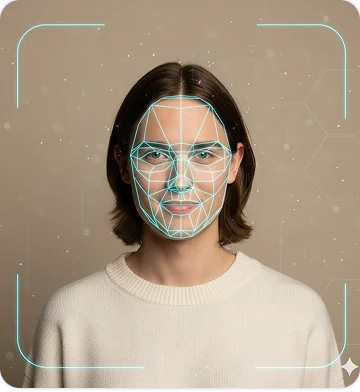
2. Private Face Mapping
MediaPipe maps 478 facial landmarks directly in your browser.

3. Get Your Results
Instantly discover your face shape and receive tailored insights for styling and grooming.
The detector combines private on-device processing with transparent geometric measurements, so you can understand both the result and its limitations.
Landmark-Based Analysis
Measures selected face proportions from a 478-point mesh.
Fast on Your Device
Runs locally after the private model loads once.
Clear Match Scores
See your closest and secondary geometric matches.
Private by Design
Your photo stays in your browser and is never uploaded.
Accessible Anywhere
Works seamlessly on mobile, tablet, and desktop.
Transparent Method
Understand the measurements, score meaning, and limitations.
Discover the unique characteristics of different face shapes and learn what styles complement your natural structure best.

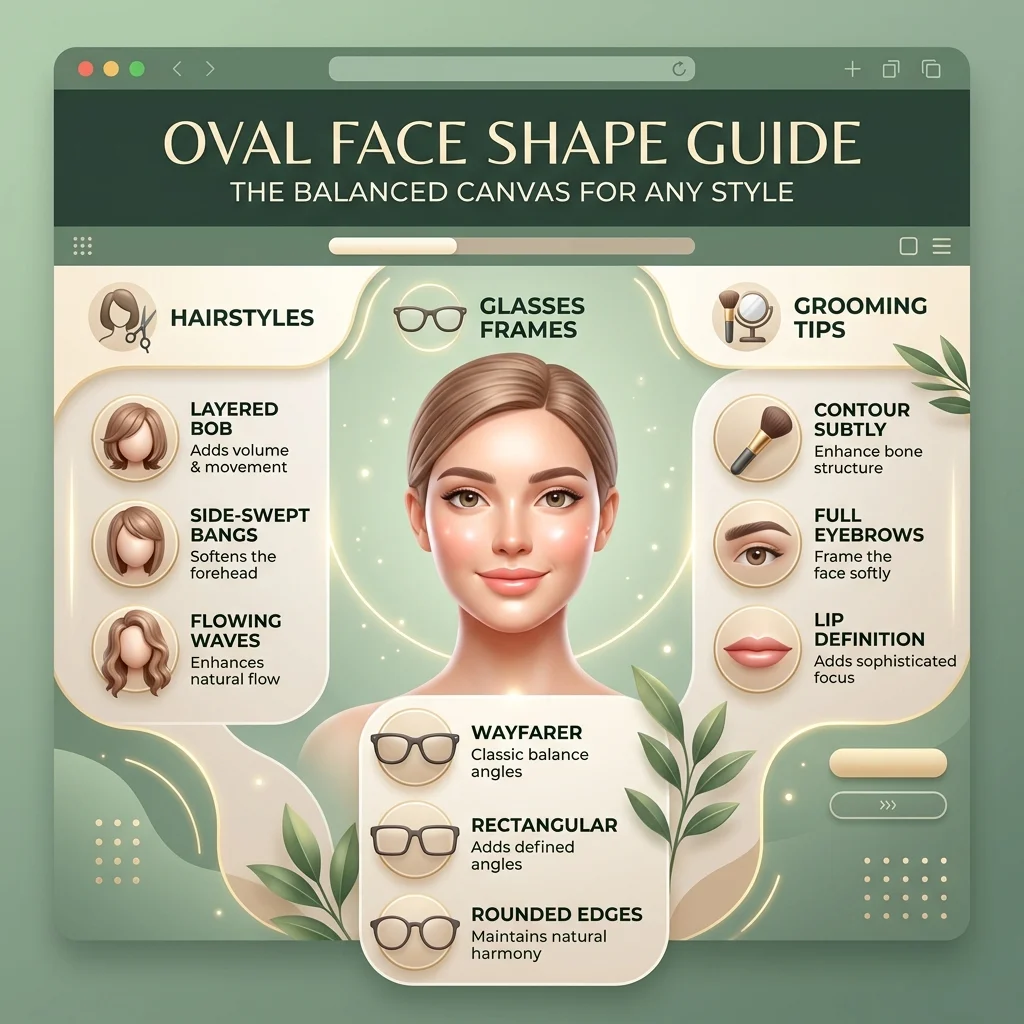
1. Oval Face
Balanced & Versatile
Oval faces are slightly longer than wide, with softly rounded edges. Known as the most versatile shape, it complements a wide range of hairstyles and accessories.

2. Round Face
Soft & Youthful
Round faces have full cheeks and a softer jawline. This shape often gives a youthful and approachable look.

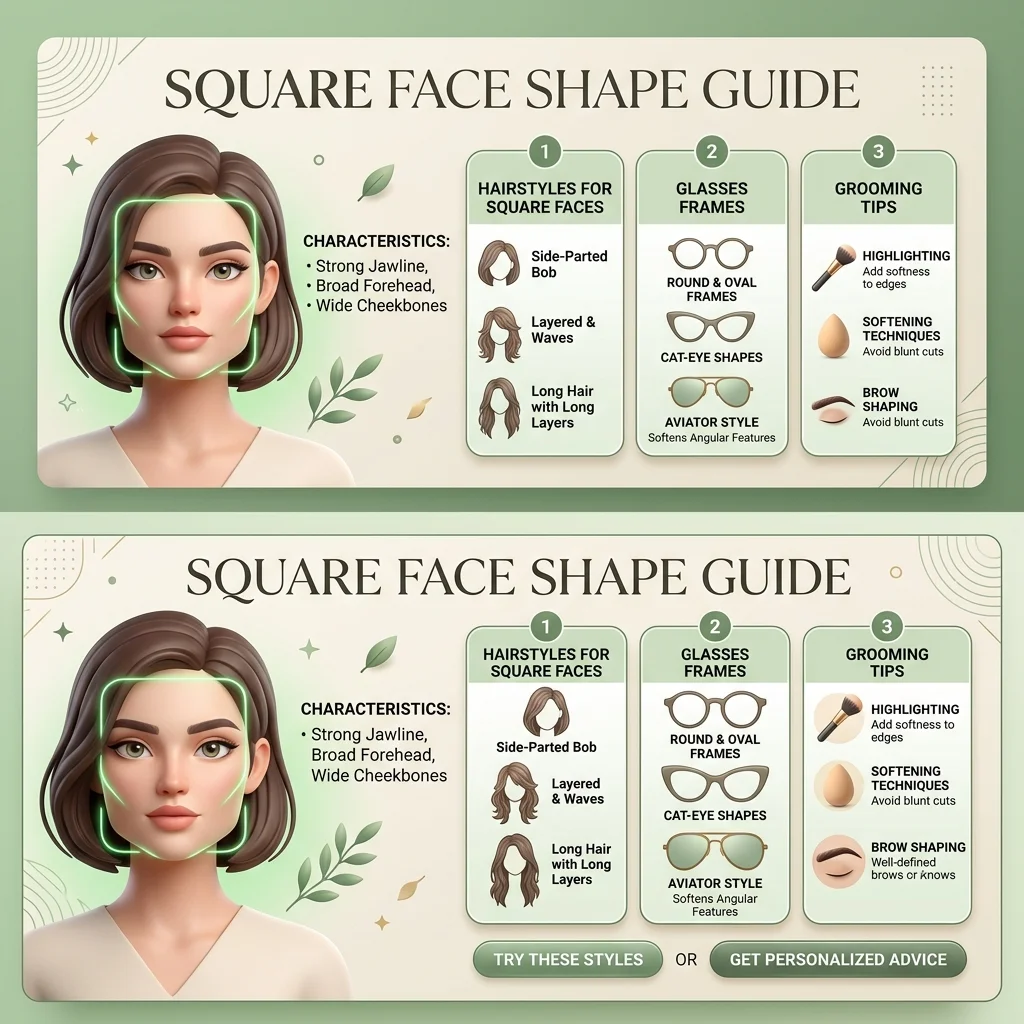
3. Square Face
Strong & Defined
Square faces are marked by a broad forehead and a strong jawline, giving a bold and confident appearance.

4. Heart Face
Charming & Distinctive
Heart-shaped faces feature a wider forehead that narrows toward the chin, creating a naturally attractive outline.

5. Diamond Face
Sharp & Elegant
Diamond faces are widest at the cheekbones with a narrow forehead and chin, giving a refined, angular look.

6. Oblong Face
Long & Refined
Oblong faces are longer than they are wide, with straight sides and a defined structure. This shape often carries a sophisticated feel.
Proportion reference
Compare the overall length, widest visible area, and jawline together. No single feature determines face shape on its own.
| Face shape | Overall proportion | Widest visible area | Jawline and chin |
|---|---|---|---|
| Oval | Moderately longer than wide | Cheekbones often slightly widest | Softly tapered jaw without strong corners |
| Round | Length and width are relatively close | Cheek area often widest | Soft, rounded jaw and chin |
| Square | Length and width may be relatively close | Upper face, cheeks, and jaw have similar widths | Broad, angular jaw |
| Heart | Balanced or slightly longer than wide | Upper face wider than jaw | Jaw narrows toward a smaller chin |
| Diamond | Usually longer than wide | Cheekbones are the widest area | Narrower upper face and tapered chin |
| Oblong | Noticeably longer than wide | Upper face, cheeks, and jaw have similar widths | Straighter sides and a longer-looking chin |
Hair, facial hair, makeup, camera angle, expression, and lighting can change how proportions appear. The detector evaluates several relationships together, but the result remains a styling estimate.
When two profiles receive close scores, use both as styling references.
See how people use the tool to explore their closest face-shape matches and styling options.
"I uploaded a clear photo and received an easy-to-understand face-shape estimate in seconds."
"The closest and secondary matches gave me a useful starting point for comparing glasses and hairstyles."
"The proportion explanation helped me understand why my result sits between oval and heart-shaped profiles."
Use a clear, front-facing photo with the cheeks, jawline, chin, and upper face visible. The detector maps facial landmarks and compares the proportions with six face-shape profiles.
Google MediaPipe Face Landmarker maps 478 points on the visible face. Selected points estimate facial proportions, which transparent rules compare with oval, round, square, heart, diamond, and oblong profiles.
It uses a machine-learning facial landmark model to locate points, then applies geometric measurements and comparison rules. It does not use generative AI to identify who you are.
The same geometric rules are applied to every suitable photo, but the result remains an estimate. Angle, lighting, expression, hair, accessories, and lens distortion can affect it; the classifier has not been independently benchmarked on a large labeled demographic dataset.
Use a sharp front-facing photo at about eye level, with a relaxed expression and even lighting. Avoid group photos, side profiles, filters, extreme angles, and anything that covers the facial outline.
No. The photo is processed locally in your browser and is not sent to our photo-analysis server, saved to an account, or added to a database.
The tool compares six profiles: oval, round, square, heart, diamond, and oblong. It can show a secondary match when your proportions share traits with more than one profile.
Human faces do not fit perfectly separated categories. Two close matches mean some proportions resemble one profile while other features resemble another.
The six geometric profiles can be used by people of any gender. The analysis uses visible proportions and does not need to determine or predict gender, identity, ethnicity, or attractiveness.
Yes. You can use it without payment, subscription, or account. No contact or payment details are required to analyze a photo.
Yes. Open the tool in a modern mobile browser and choose a clear front-facing photo. The image analysis still runs locally on your device.
No. Face-shape labels are broad geometric categories used for styling guidance. They do not diagnose health, identify a person, measure attractiveness, or define how someone should look.

SEO Expert & Web Strategist
Focused on helping people make practical styling choices with clear, privacy-conscious technology.
As the founder of Detect Face Shape, Anam aims to make geometric face-shape guidance easy to understand while keeping photo analysis on the user’s device.
Discover tips, guides, and insights about face shapes.