Glasses for Long Face Shapes: The Best Frames and Fit
Find the best glasses for long face shapes, from square and cat-eye to aviator frames, plus practical advice on width, bridge, lens depth, and fit.


Table of Contents
14 SectionsChoosing glasses for long face shapes is mostly about proportion. Frames with visible lens depth, a defined top line, and enough horizontal presence can make a long or oblong face look more balanced. Tall square, softly rectangular, wayfarer, browline, cat-eye, and deep aviator styles are strong starting points.
Shape is only half the decision, though. The frame still needs to match your head width, sit securely on your nose, clear your cheeks, and work with your prescription. A flattering oversized frame that slips or places your pupils awkwardly is not a good choice. This guide explains how to recognize a long face, compare the most useful frame shapes, and judge fit without treating face-shape rules as laws. The aim is not to hide your features, but to find eyewear that looks intentional and feels comfortable all day.
Quick answer
The best glasses for long face shapes have noticeable lens depth and enough width to balance facial length. Start with tall square, softly rectangular, wayfarer, browline, cat-eye, or deep aviator frames. Choose a front about as wide as your face, then confirm the bridge, pupils, temples, and prescription all fit properly.
Is your face long, oblong, oval, or rectangular?
“Long face” is a broad styling term, not a medical classification. It usually describes a face that is clearly longer than it is wide. An oblong face shape often has a forehead, cheekbones, and jawline of similar width, with fairly straight sides. A rectangular face has similar long proportions but a more angular jaw. A long oval face tends to taper more gently toward the forehead and chin.
You do not need a perfect label to choose frames. Pull your hair back, face a mirror or straight-on photo, and compare four features:
- Face length, from the center of the hairline to the chin
- Forehead width at its widest point
- Cheekbone width beneath the outer corners of the eyes
- Jaw width from one side to the other
If length is the dominant measurement and the other three widths are fairly close, “oblong” is a useful working description. If the jaw has strong corners, rectangular may be more accurate. If the face narrows noticeably at both ends, it may be a long oval.
These distinctions change the fine details, not the whole strategy. Most long faces benefit from frames that create a clear horizontal break and do not look shallow. Angular frames add structure to softer features; curved frames can soften a firm jaw.

Best glasses for oblong face shapes at a glance
The best glasses for oblong face shapes are usually medium to deep from top to bottom. Width matters too, but “wide” should mean well proportioned—not a frame that projects far beyond the temples.
| Frame style | Why it often works | Look for | Be careful with |
|---|---|---|---|
| Tall square | Adds structure and visual width | Clear corners and generous lens height | Very boxy frames on an already angular jaw |
| Soft rectangle | Creates a horizontal break without looking severe | Rounded corners and medium-to-deep lenses | Shallow “letterbox” rectangles |
| Wayfarer | Gives weight to the brow and balances facial length | A substantial top rim and slight lens depth | Tiny, narrow versions |
| Browline | Draws attention toward the eyes and upper face | A strong but well-fitted upper rim | A top-heavy frame that sits above the brows |
| Cat-eye | Lifts the outer corners and adds width | Moderate upsweep and adequate lens height | Extreme wings that extend past the face |
| Aviator | Uses a broad top line and deep lenses | A size that clears the cheeks | Oversized lenses that touch the cheeks |
| Round or oval | Softens an angular jaw | Medium or large lenses with real depth | Small, narrow circles that emphasize length |
This table is a shortlist, not a rulebook. Two frames sold under the same shape name can fit very differently. A deep, softly rounded rectangle may balance a long face better than a shallow square.

Why width and lens depth matter more than the label
Frame depth is the top-to-bottom height of the lens area. On a long face, greater depth occupies more vertical space around the eyes. A visible browline or bold upper rim also creates a horizontal stop, so the eye does not read the face as one uninterrupted vertical line.
Width has a different job: it brings attention outward. The frame front should generally align with the width of the head at the temples. A little visual flare can work, especially in a cat-eye, but hinges that sit far beyond the face usually signal an oversized fit rather than useful balance.
This explains why conflicting style advice can both sound reasonable. Some guides recommend square frames while others suggest round or aviator shapes. All can work if the lenses have enough height and the frame is in scale with the wearer. A tiny round frame can make a face appear longer; a deep round frame may soften angles and create excellent balance.
Bridge position also changes the visual result. A lower bridge or keyhole bridge can break up the length of the nose, while a high bridge may make the central line appear longer. Treat that as an optical effect, not a fixed restriction: the bridge first has to fit your nose securely.
Are square glasses for oblong face shapes the safest choice?
Square glasses for oblong face shapes are a reliable option because their horizontal and vertical lines add structure around the eyes. They are especially effective when the face is long and narrow but the jaw is soft or rounded. Thick acetate can create more presence; thin metal offers the same geometry with a lighter effect.
For a rectangular face with a strong jaw, a rigid square may repeat every angle. That can look bold and deliberate, but it is not the only flattering choice. Rounded-square or softly rectangular frames keep the balancing width while easing the sharpness.
Lens height is the deciding detail. Tall square frames usually work better than shallow rectangles. If you prefer a compact style, choose one with a strong top bar or a little extra depth instead of a very thin strip across the eyes.
The top rim should follow the general line of your eyebrows without covering them completely. Your eyes should look comfortably placed within the lenses, and the lower rim should not lift when you smile. Those fit signals matter more than whether the product page calls the frame “square,” “geometric,” or “modified rectangle.”

The best glasses for rectangular face shapes
People often use rectangular and oblong interchangeably, but the jawline can guide the final choice. The best glasses for rectangular face shapes usually add width while softening, rather than repeating, a sharply defined jaw.
Good options include:
- Rounded-square frames with softened corners
- Deep oval or round frames that are not too small
- Aviators with curved lower lenses
- Browline frames with a lighter lower rim
- Subtle cat-eyes with a smooth upsweep
If you like a strong architectural look, square acetate can still work. Match the frame to your personal style rather than trying to “correct” your face. A bold jaw plus a bold frame reads as confident; a curved frame creates contrast and a softer result.
Very narrow rectangular frames are harder to balance because they add a second long horizontal line without occupying much vertical space. They may suit a deliberate minimalist or retro look, but they are not the easiest everyday choice for most long rectangular faces.
Choosing a glasses shape for a long narrow face
With a long, narrow face, scale becomes more important than size labels such as small, medium, or large. The ideal glasses shape for long narrow face proportions has enough lens height to divide the face visually, while the overall frame remains close to the actual temple width.
Try tall square, panto, browline, or compact aviator frames. A panto frame is rounded below with a slightly flatter brow line; it provides softness without looking like a small circle. Transparent or fine-metal frames can give you generous lens depth without making delicate features feel overwhelmed.
Avoid assuming that a narrow face needs narrow-looking lenses. A physically well-fitted frame can have a deep, expressive silhouette. The useful combination is a narrower total front with taller lenses—not a wide frame scaled down only by shortening the temple arms.
For a petite head, check whether the brand offers narrow-width or petite versions. Product photos can be misleading, so compare the full frame width when it is listed. Your current best-fitting pair is also a practical reference point.

Glasses for long face men and women: what really changes?
Retailers often separate men’s frames from women’s collections, but the balancing principles are the same. Head width, bridge anatomy, brow line, cheek clearance, prescription, and personal style matter more than the gender label on a product page.
People seeking men’s glasses for an oblong face often prefer tall wayfarers, square acetate frames, navigator shapes, or browlines. These create a defined brow and can add structure around softer cheeks. A beard adds visual width to the lower face, so a medium-weight frame may be enough; a very heavy frame is not automatically better.
For women’s eyeglasses on a long face, cat-eye, butterfly, oversized square, deep oval, and colorful browline designs are popular choices. A moderate cat-eye adds width near the temples and lifts attention toward the eyes. Frames do not need to be oversized to achieve that effect.
Anyone can wear any of these styles. Use collection labels only as a shopping filter for available sizes and colors. If a frame fits and supports the look you want, the marketing category is irrelevant.
Fit comes before face-shape advice
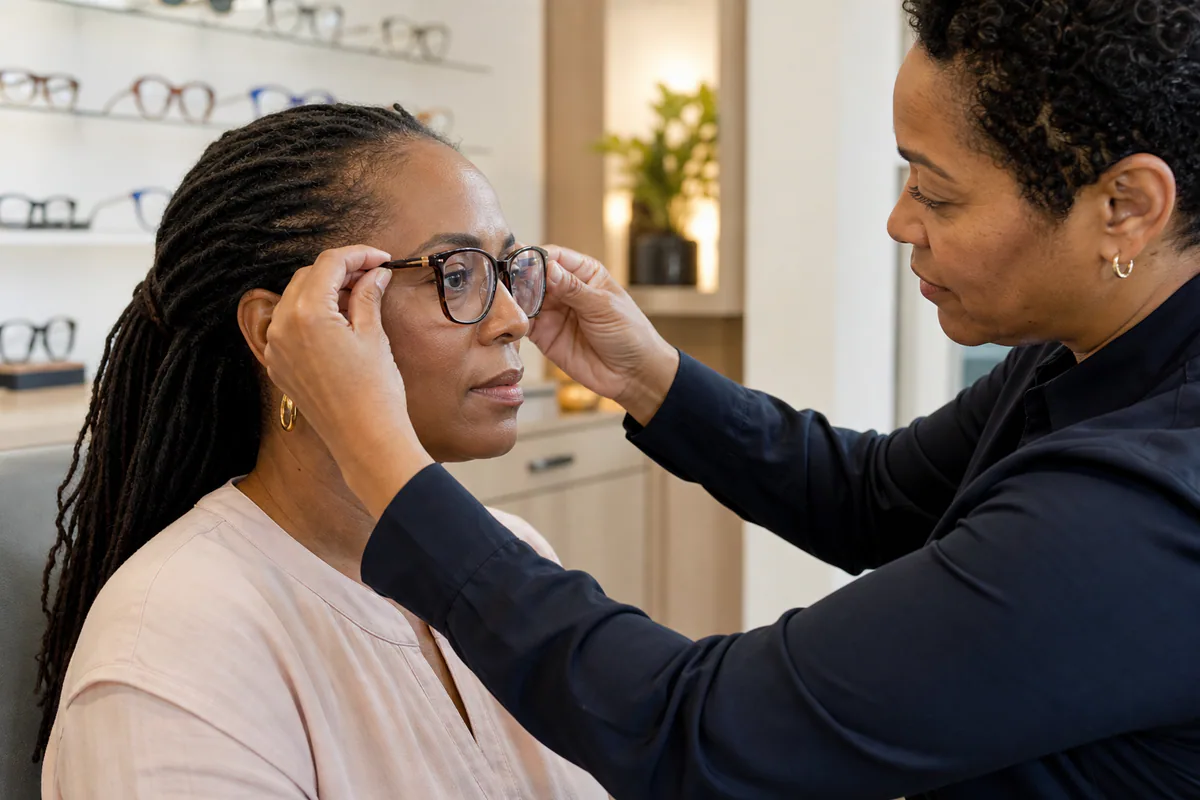
A frame can flatter your proportions and still be wrong for daily wear. The Vision Council’s dispensing guide advises choosing a frame front approximately as wide as the wearer’s head and checking that the eye size and bridge are appropriate. The Association of British Dispensing Opticians likewise notes that frame width should match face width and pupils should sit approximately in the lens centers.
Use this fit check while looking straight ahead:
- Frame width: The temples should travel back without bowing outward or pressing into the sides of your head.
- Bridge: The frame should make stable contact without pinching, leaving deep marks, or sliding. Adjustable nose pads or a low-bridge fit can help when standard molded bridges leave gaps or cause cheek contact.
- Eye position: Your pupils should appear reasonably placed within the lens openings. An optician uses pupillary distance and fitting measurements to position the optical centers correctly.
- Cheek clearance: The lower rims should not rest on your cheeks or move noticeably when you smile.
- Temple length: The arms should bend comfortably behind the ears, without a large gap or strong pressure.
- Brow relationship: The upper rim usually looks most natural near the brow line, rather than far above it or hiding it completely.
The familiar numbers inside a temple—such as 52–18–140—usually represent lens width, bridge width, and temple length in millimeters. They are useful for comparing similar designs, but they do not reveal total front width, lens height, bridge shape, or how a frame’s curves will sit on your face. Use them as reference points, not a guaranteed fit formula.
Prescription needs may narrow your choices. Very large lenses can add thickness, weight, or peripheral distortion with stronger prescriptions. Progressive lenses need enough usable vertical space for their viewing zones. Ask an optician to review the frame before ordering lenses if you have a strong prescription, progressives, prism, or a difficult bridge fit.
Color, rim weight, and material can fine-tune the effect
Shape establishes the outline; color and material control how strongly it appears. Dark tortoiseshell, black, navy, and saturated colors make the frame more visible and can create a stronger horizontal break. Clear crystal, translucent acetate, and fine metal keep deep frames visually light.
A bold browline pulls attention upward and outward. Decorative temples can add side emphasis, though they will be less visible from the front. Two-tone frames with a darker top and lighter bottom can define the eyes without weighing down the whole face.
Use contrast deliberately:
- Choose thick acetate or a dark upper rim for a graphic, structured look.
- Choose rounded corners, translucent colors, or thin metal to soften an angular face.
- Choose warm tortoise, olive, bronze, or honey if those colors suit your skin and hair.
- Choose black, silver, clear gray, navy, or jewel tones if cooler contrast feels more natural.
Skin undertone can help narrow colors, but it should not overrule preference. Try frames in normal daylight if possible. Camera filters, bright store lighting, and virtual try-on tools may shift color or scale.
Sunglasses for an oblong face
The same proportion rules apply to sunglasses, with more room for coverage. Deep aviators, wayfarers, butterfly frames, tall squares, and softly rounded oversized styles can all balance a long face. For oblong face sunglasses male shoppers, navigators and deep wayfarers offer a straighter alternative to a classic teardrop aviator—but these styles are not limited by gender.
Do not let styling replace eye protection. The American Optometric Association recommends sunglasses that block 100% of UVA and UVB radiation. Dark tint alone does not prove UV protection. For glare from roads or water, polarized lenses can improve comfort, but polarization and UV blocking describe different features.
Check coverage and fit as well. The frame should sit securely, provide useful coverage around the eyes, and avoid touching the cheeks. Highly curved wraparound sunglasses offer side coverage, but some prescriptions need special lens designs, so confirm compatibility with an optician.

Frames to avoid—and common shopping mistakes
No shape is universally forbidden. “Avoid” really means “check with extra care.” These choices are more likely to exaggerate length or create fit problems:
- Very shallow rectangles: They can look like a narrow stripe and leave most of the face’s vertical length uninterrupted.
- Tiny round frames: Small circles may look out of scale on a longer face, especially if they are also narrow.
- Rimless frames with little depth: They add minimal visual structure. This may be perfect for an understated look, but it will not create much balancing width.
- Frames much wider than the temples: Oversizing can cause slipping, poor eye placement, and arms that flare outward.
- A poor bridge chosen for style: A keyhole or low bridge changes the look only if it also sits securely.
- Overly deep frames that touch the cheeks: Lens depth helps until it interferes with movement or comfort.
Another mistake is treating a face-shape guide as an objective beauty test. Hair, eyebrows, nose shape, eye spacing, facial asymmetry, and personal style all affect the result. Face shape helps you build a fitting-room shortlist; the mirror and a proper adjustment make the final decision.
How to choose eyeglasses for a long face in 10 minutes
Use this quick process online or in a shop:
- Pick three families: one angular, one curved, and one bold-brow style.
- Start with medium or generous lens depth rather than a shallow lens.
- Match the front to your temple width; do not chase width by oversizing.
- Compare the bridge with a pair that already fits you well.
- Look straight ahead and check eye position, brows, and cheek clearance.
- Turn sideways to inspect temple pressure and arm length.
- Smile, look down, and gently move your head to test stability.
- Photograph each pair from the same distance in neutral light.
- Confirm that the frame works with your lens type and prescription.
- Choose the pair that still feels comfortable after several minutes, not just the most dramatic first impression.
If you are shopping online, use virtual try-on to compare silhouettes, not to certify fit. Verify measurements against a comfortable current pair and choose a retailer with a workable return or adjustment policy.
Choose proportion first, then personality
The most reliable glasses for long face proportions are deep enough to frame the eyes and wide enough to create balance, without becoming physically oversized. Tall square, softened rectangle, wayfarer, browline, cat-eye, aviator, and deeper rounded styles all meet that goal in different ways.
Begin with the shape that creates the mood you want: angular for definition, curved for softness, or a bold brow for emphasis. Then let fit decide. A secure bridge, appropriate width, comfortable temples, clear cheeks, and lenses suited to your prescription will matter every day after the face-shape label is forgotten.
Anam Ahsan
Founder & Beauty Tech Strategist
Focused on making practical styling choices with clear, privacy-conscious technology. Passionate about empowering individuals to understand facial geometry, bite dynamics, and personalized aesthetic harmony.
Want to Know Your Exact Face Shape?
Identify your jawline angle, cheekbone prominence, and face proportions in seconds. 100% on-device processing—your photo never leaves your browser.
Detect My Face Shape FreeRelated Articles
Explore more expert guides on face shapes, styling, and profile harmony.
 Glasses
 Best Eyeglasses for Your Face Shape: The Complete Guide 2026
Find the perfect eyeglasses frames for your face shape. Expert guide covering oval, round, square, heart, diamond, oblong & triangle faces with frame recommendations, tips & FAQs.
 Glasses
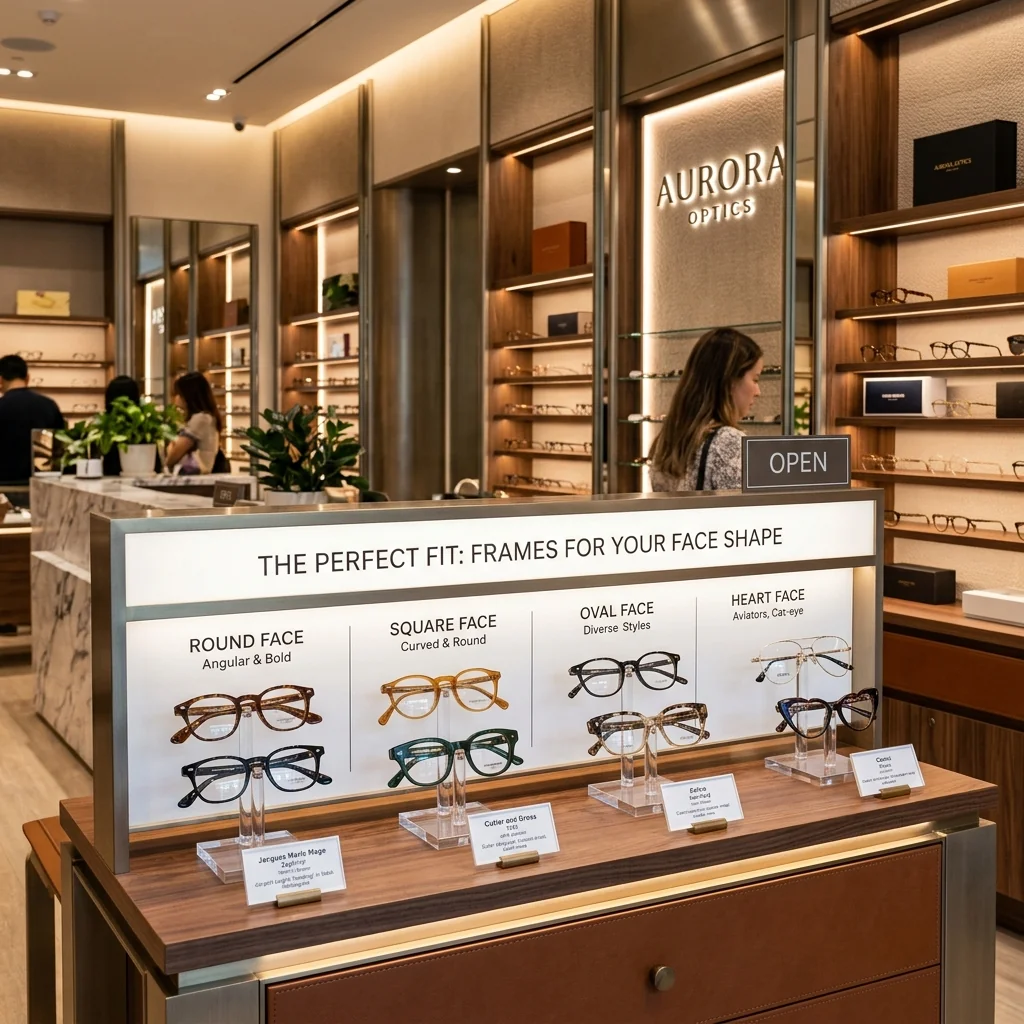
 Which Glasses for My Face Shape? The Ultimate Eyewear Guide 2026
Discover the perfect glasses frames for your face shape. Expert guide covering oval, round, square, heart, diamond, oblong & triangle faces with frame recommendations, tips & FAQs.
 Dental & Orthodontics
 Jawline Before and After Braces: How Face Shape Can Change
Learn how braces may change your jawline, lips, and face shape, what before-and-after photos really show, and why results differ between adults and teenagers.